Workplace
The Quiet Promotion Trap: Why High Performers Get More Work — Not More Pay
조용한 승진의 함정: 왜 최고 성과자는 일만 더 하고 급여는 그대로일까
읽기 도움말단어 수준자주 쓰는 3,000 단어가 본문의 87%예요. 그 밖의 단어는 100단어에 13개꼴이에요.
- 1K66%
- 2K12%
- 3K9%
- 5K6%
- 5K+7%
5,000 단어 밖 contributor · commensurate · stark · burnout · voluntarily · eighteen · organizational · willingness
The Problem
You Got a Great Review. Now Here Comes More Work.
최고 평가를 받았어요. 그리고 더 많은 업무가 찾아왔어요.
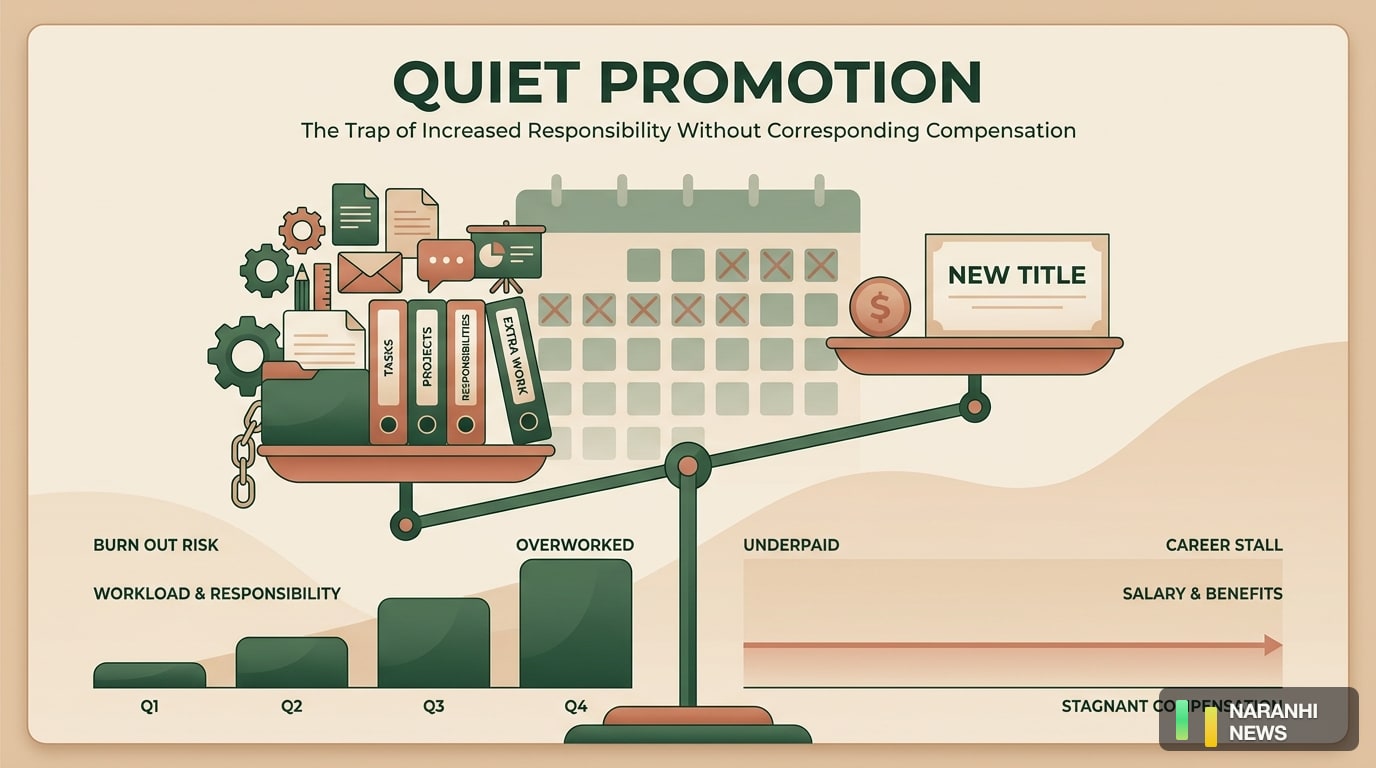
Imagine this: your annual performance review comes back glowing. Your manager calls you a "top contributor." You walk out of that meeting feeling proud — and then, over the next three months, you quietly receive twenty-three percent more work than your colleagues. No salary increase. No promotion. No new title. Just more tasks — because you proved you could handle them. This is the quiet promotion — and a new Harvard Business Review analysis of 1,400 performance reviews has now put hard numbers on a phenomenon that millions of workers have long suspected but could not prove.
이런 상황을 상상해보세요: 연간 성과 평가(performance review)에서 최고 점수를 받았어요. 매니저는 당신을 "최고 기여자"라고 부르고, 회의실을 나설 때는 자랑스러운 기분이 들죠. 그런데 이후 석 달 동안 동료보다 23% 더 많은 업무가 조용히 쌓이기 시작해요. 연봉 인상도 없고, 승진도 없어요. 직함 변경도 없죠. 그저 더 많은 업무만 — 당신이 감당할 수 있다는 걸 증명했으니까요. 이것이 바로 조용한 승진(quiet promotion)이에요 — 그리고 1,400건의 성과 평가를 분석한 HBR(하버드 비즈니스 리뷰)의 최신 연구가 수백만 명의 직장인들이 오래전부터 의심해왔지만 증명하지 못했던 현상에 마침내 숫자를 붙였어요.
The Research
23% More Tasks. Zero Extra Pay.
업무는 23% 더. 추가 보상은 0.
Researchers analyzed 1,400 performance reviews from companies across six industries over twenty-four months, tracking what happened to employees in the quarter immediately following a top rating. Employees rated "exceeds expectations" received, on average, twenty-three percent more tasks in the following quarter — with no increase in compensation, no formal title change, and no additional staffing to share the load. The consequence was stark: top performers subject to quiet promotion experienced a forty-one percent higher rate of and were nearly twice as likely to voluntarily resign within eighteen months compared to equally skilled colleagues who received average ratings. The HBR analysis also found that quiet promotion was more common in high-performance cultures than in average-performer environments — a pattern that reflects the dynamics of elite professional settings, where organizational loyalty and the willingness to absorb additional responsibility are treated as evidence of readiness for promotion that rarely materializes.
연구팀은 6개 산업군에 걸친 기업들의 1,400건 성과 평가를 24개월에 걸쳐 분석하며, 최고 등급을 받은 직후 분기에 해당 직원들에게 어떤 일이 생겼는지 추적했어요. "기대치를 초과(exceeds expectations)" 등급을 받은 직원들은 다음 분기에 평균 23% 더 많은 업무를 받았어요 — 그에 상응하는(commensurate) 보상 인상도, 공식적인 직함 변경도, 업무를 나눠줄 추가 인력도 없이 말이에요. 그 결과는 냉혹했어요: 조용한 승진을 겪은 최고 성과자들은 번아웃(burnout) 발생률이 41% 더 높았고, 동등하게 유능하지만 평균 등급을 받은 동료에 비해 18개월 내 자발적 퇴사 가능성이 거의 두 배에 달했어요. HBR 분석은 또한 조용한 승진이 평균 성과 문화보다 고성과 문화에서 더 흔하다는 것을 발견했어요. 엘리트 전문직 환경의 역학을 반영하는 패턴이에요. 이런 환경에서는 조직 충성도와 추가 책임을 기꺼이 흡수하는 의지가 좀처럼 실현되지 않는 승진에 대한 준비도의 증거로 취급돼요.
The Mechanism
It's Not Malicious — It's the System.
의도적인 게 아니에요 — 구조의 문제예요.
Understanding the quiet promotion trap requires seeing it from the manager's perspective: when a difficult project lands, the instinct is to assign it to the most capable person — the high performer. It is efficient. It is rational. And it is quietly destructive. The problem is structural: most organizations have performance review systems that measure output quality but not fairness. There is no alert when one employee's task pile grows twenty-three percent. The budget for raises is fixed. The path of least resistance is to reward excellence with more work, not more pay. The pattern also has a psychological dimension that makes it self-perpetuating. Employees who receive glowing reviews and expanded responsibilities naturally conclude they are on track for formal recognition — leading them to work even harder to demonstrate readiness. This is the trap's most elegant and cruel feature: the employee's own belief that promotion is coming keeps them in the cycle. Organizations are not always consciously exploiting their best workers. In many cases, the quiet promotion cycle reflects a genuine management failure: the inability to translate observed performance into timely compensation decisions. Approval chains, budget cycles, and HR process friction mean that even well-intentioned managers often fail to act on their own recognition of an employee's expanded contributions.
조용한 승진의 함정을 이해하려면 매니저의 시각에서 봐야 해요: 어려운 프로젝트가 생기면 가장 유능한 사람, 즉 최고 성과자에게 맡기는 것이 본능적인 반응이에요. 효율적이고, 합리적이죠. 그리고 조용히 파괴적이에요. 문제는 구조적이에요: 대부분의 조직은 산출물의 질은 측정하지만 업무량(workload) 형평성은 측정하지 못하는 성과 평가 시스템을 가지고 있어요. 한 직원의 업무가 23% 늘어나도 경보가 울리지 않아요. 인상 예산은 고정되어 있고, 가장 쉬운 길은 탁월함에 더 많은 급여가 아닌 더 많은 업무로 보상하는 거예요. 이 패턴은 스스로를 영속시키는 심리적 차원도 있어요. 훌륭한 평가와 확대된 책임을 받는 직원들은 자연스럽게 공식적인 인정을 향해 나아가고 있다고 결론짓고, 준비도를 증명하기 위해 더 열심히 일하게 돼요. 이것이 함정의 가장 우아하고 잔인한 특징이에요. 승진이 올 것이라는 직원 자신의 믿음이 그들을 사이클 안에 머물게 해요. 조직이 항상 의식적으로 최고의 직원들을 착취하는 것은 아니에요. 많은 경우 조용한 승진 사이클은 진정한 관리 실패를 반영해요. 관찰된 성과를 적시 보상 결정으로 전환하는 능력의 부재예요. 승인 체계, 예산 주기, HR 프로세스의 마찰로 인해 심지어 선의의 관리자들도 직원의 확대된 기여를 인식하면서도 행동하지 못하는 경우가 많아요.
Context
A Universal Trap — From London to Seoul
런던에서 서울까지 — 보편적인 함정
Quiet promotion is not uniquely American. Gallup's 2026 Global Workplace Report finds that " fairness" is now the number-one driver of employee disengagement globally — overtaking compensation for the first time — affecting workers in the UK, Germany, Japan, and South Korea equally. In South Korea, the phenomenon carries particular cultural weight. The concept of 눈치 — the unspoken social intelligence to read situations and adjust behavior accordingly — can work against employees expected to absorb expanding responsibilities without explicitly negotiating, because raising the issue directly may be read as a lack of team spirit. Younger Korean workers, however, appear to be developing stronger norms around explicit negotiation. A 2026 survey by job portal Saramin found that 61% of workers under 35 said they would directly raise the workload-compensation mismatch with their manager — compared to only 38% of workers over 45, suggesting that cultural tolerance for quiet promotion may be eroding faster in this cohort than institutions expect.
조용한 승진은 미국만의 현상이 아니에요. 갤럽의 2026 글로벌 직장 보고서는 "업무량 형평성"이 이제 처음으로 급여를 제치고 전 세계 직원 이탈의 1위 원인이 됐다고 밝혔어요 — 영국, 독일, 일본, 한국 모두 똑같이 영향받고 있어요. 한국에서 이 현상은 특별한 문화적 무게를 지녀요. 상황을 읽고 그에 따라 행동을 조정하는 무언의 사회적 지능인 '눈치' 개념은 조건을 명시적으로 협상하지 않고 확대되는 책임을 흡수하도록 기대받는 직원들에게 불리하게 작용할 수 있어요. 문제를 직접 제기하면 팀 정신 부족으로 읽힐 수 있기 때문이에요. 그러나 젊은 한국 직장인들은 명시적 협상에 대해 더 강한 규범을 발전시키고 있는 것 같아요. 취업 포털 사람인의 2026년 설문조사에 따르면 35세 미만 직장인의 61%가 업무량-보상 불일치를 매니저에게 직접 제기하겠다고 답했어요. 이는 45세 이상 직장인의 38%와 비교되는 수치로, 조용한 승진에 대한 문화적 관용이 이 세대에서 더 빠르게 사라지고 있을 수 있어요.
Quick fix
Name It to Claim It — and What to Say
이름을 붙여야 바꿀 수 있어요 — 그리고 뭐라고 말할지
Your first move is to name what is happening — a quiet promotion — then schedule a direct conversation with your manager to align your compensation with your actual scope, before exhaustion has to make the argument for you.
조용한 승진의 함정에 맞서는 첫 번째 방어는 그것을 이름으로 인식하는 거예요. 마지막 우수 성과 평가 이후 업무량(workload)이 크게 늘었는데 보상은 그에 상응하게(commensurately) 따라오지 않았다면, 지금 당신이 이 함정에 있을 가능성이 높아요 — 그리고 "업무량 형평성(workload equity)"과 "역할 범위 확장(scope creep)"이라는 어휘는 번아웃(burnout)이 대신 이야기하게 되기 전에 매니저에게 먼저 꺼낼 수 있는 언어를 줄 거예요.
Recall
다시 읽기 전에, 떠올려 보세요
한국어 문장을 보고 빈칸에 들어갈 영어 표현을 써 보세요. 다시 읽는 것보다 기억에서 꺼내 볼 때 더 오래 남아요.
이 칼럼이 마음에 드셨나요?
새 칼럼이 발행되면 영문 + 한글 본문을 통째로 메일로 보내드려요. 매일 아침, 광고 없이.
언제든 한 번에 해지할 수 있어요.