Workplace
Return-to-Office Is Backfiring: Stanford Data Reveals the Hidden Turnover Cost
출근 강제, 역풍 맞다: 스탠퍼드 데이터가 밝힌 숨겨진 이탈 비용
읽기 도움말단어 수준자주 쓰는 3,000 단어가 본문의 83%예요. 그 밖의 단어는 100단어에 17개꼴이에요.
- 1K66%
- 2K10%
- 3K7%
- 5K10%
- 5K+7%
5,000 단어 밖 eighteen · directive · eroded · weakened · accountability · reclaim · verdict · backlash
The Data Is In
Companies Ordered Staff Back. Top Talent Walked Out.
기업들이 출근을 명령했어요. 핵심 인재들이 떠났습니다.
For the past eighteen months, a wave of major US corporations — from Amazon and JPMorgan to Goldman Sachs and Dell — issued the same directive to their employees: return to the office, five days a week, no exceptions.
지난 18개월 동안, 아마존·JP모건·골드만삭스·델까지 미국의 주요 대기업들이 직원들에게 같은 지시를 내렸어요: 주 5일, 예외 없이 사무실로 돌아오라고요.
The argument from leadership was consistent: remote work had collaboration, weakened company culture, and made accountability harder to enforce — and it was time to reclaim what only shared physical space could provide.
경영진 측 주장은 일관됐어요: 재택근무가 협업을 약화시키고, 기업 문화를 훼손하고, 책임감을 강요하기 어렵게 만들었으며, 이제 공유 공간만이 줄 수 있는 것을 되찾을 때라는 거였죠.
Now, the first large-scale academic data on the consequences of those mandates has arrived — and the findings deliver a clear, uncomfortable verdict: strict return-to-office policies are driving away the employees companies can least afford to lose. The backlash was not limited to exit surveys. Several companies that enforced strict five-day mandates subsequently reported in their 10-K filings that 'talent retention' had become a material risk factor in their human capital disclosures — a regulatory language shift that signals how seriously boards are now taking the downstream consequences.
이제 그 강제 복귀 명령의 결과에 관한 첫 번째 대규모 학술 데이터가 나왔는데, 분석 결과는 명확하고 불편한 판정을 내려요: 엄격한 출근 복귀 정책이 기업들이 가장 잃어서는 안 되는 직원들을 쫓아내고 있다는 거예요. 반발은 퇴직 설문조사에만 국한되지 않았어요. 엄격한 주 5일 명령을 시행한 여러 기업들이 이후 10-K 공시에서 '인재 유지'가 인적 자본 공시의 중요한 위험 요인이 되었다고 보고했어요. 이사회가 이제 그 결과의 심각성을 얼마나 진지하게 받아들이는지를 알리는 규제적 언어의 변화예요.
The Research
34% More Turnover. The Numbers Don't Lie.
이직률 34% 상승. 숫자는 거짓말하지 않아요.
Researchers at Stanford's Institute for Economic Policy Research tracked over six hundred US companies across eighteen months, comparing firms enforcing strict five-day return-to-office mandates against those operating on hybrid or flexible models.
스탠퍼드 경제정책연구소(SIEPR) 연구팀은 18개월에 걸쳐 600개 이상의 미국 기업을 추적하며, 엄격한 5일 전면 출근 명령을 강행한 기업과 하이브리드·유연 근무를 운영하는 기업을 비교 분석했어요.
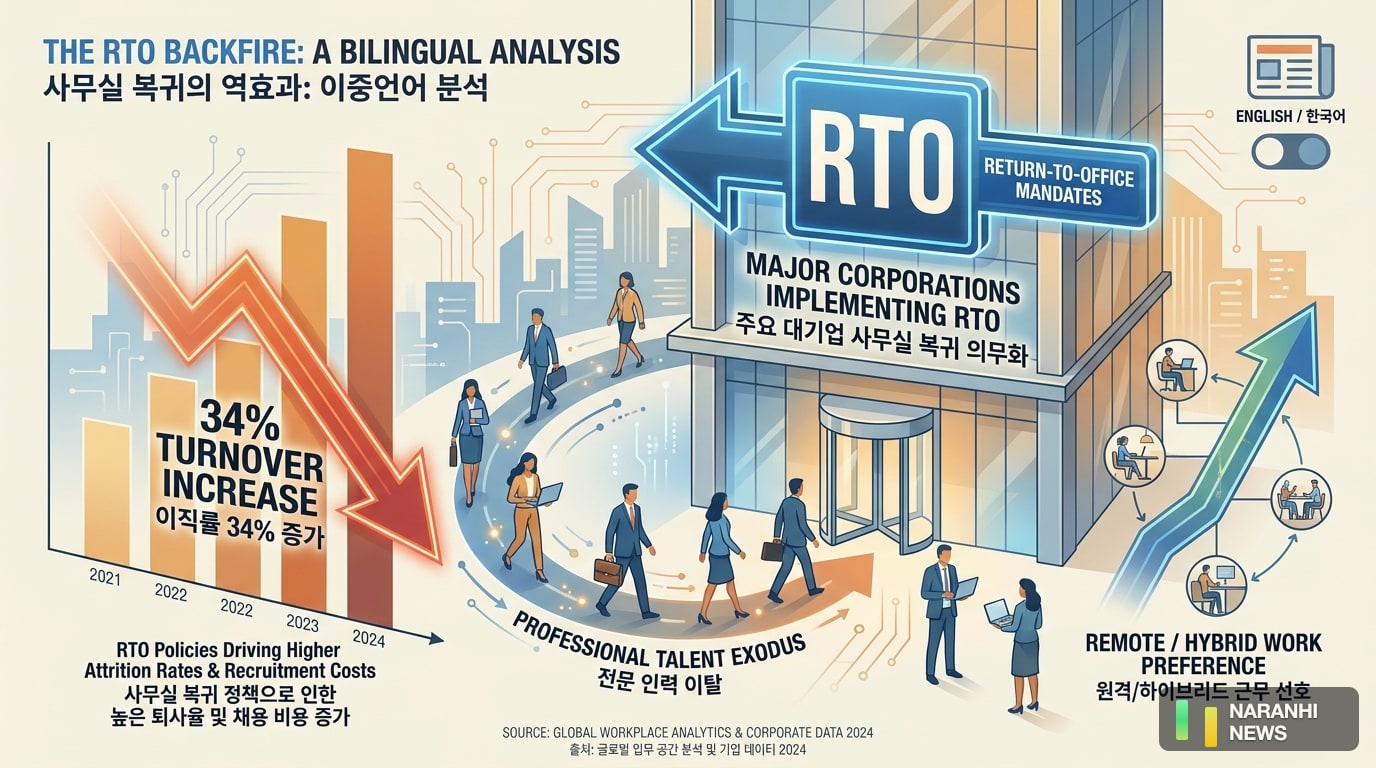
Their central finding: companies enforcing strict RTO mandates experienced a 34% higher rate of voluntary turnover among top performers — a that is now forcing HR leaders to rethink the business case for mandatory attendance policies.
핵심 결론은 이랬어요: 엄격한 RTO(출근 복귀) 명령을 강행한 기업들은 우수 인재의 자발적 이직률이 34% 더 높게 나타났으며, 이는 HR 리더들이 의무 출근 정책의 사업적 타당성을 재검토하도록 강요하는 필연적 결과가 됐어요.
The was not evenly distributed across the workforce — it hit women, primary caregivers, and employees over forty-five the hardest, precisely the groups that companies consistently say they are most committed to retaining.
이 이탈은 노동력 전반에 고르게 분포된 게 아니었어요 — 기업들이 가장 유지하고 싶다고 늘 말해온 바로 그 집단, 즉 여성, 주 돌봄 제공자, 45세 이상 직원들에게 가장 큰 타격을 줬어요.
A separate LinkedIn Workforce Report published in April 2026 adds another striking data point: job postings that require full-time office attendance receive 58% fewer applications from workers with ten or more years of experience. The gender dimension of the findings is particularly striking because it runs counter to the public rationale many companies offered for their RTO mandates. Several major employers publicly argued that in-office work would improve mentorship and career visibility for junior employees — implying it would particularly benefit women and younger workers. The Stanford data suggests the exact opposite occurred. The researchers also distinguished between 'hard mandates' — enforced through monitoring and formal consequences — and 'soft expectations' where in-office attendance was strongly encouraged but not formally penalized. Companies in the hard category showed rates roughly double those of the soft expectation group, suggesting the enforcement mechanism itself, not just the requirement, drives the most damaging outcomes.
2026년 4월 링크드인 노동력 보고서는 또 다른 놀라운 데이터를 추가해요: 전일 사무실 출근을 요구하는 채용 공고는 경력 10년 이상 지원자로부터 58% 더 적은 지원을 받아요. 연구 결과의 성별 차원은 많은 기업들이 RTO 명령에 대해 공개적으로 제시한 근거와 상충하기 때문에 특히 두드러져요. 여러 주요 고용주들은 사무실 근무가 주니어 직원들의 멘토링과 커리어 가시성을 높일 것이라고 공개적으로 주장했어요. 특히 여성과 젊은 직장인들에게 도움이 될 것이라고 암시하면서요. 스탠퍼드 데이터는 정반대가 발생했음을 시사해요. 연구자들은 모니터링과 공식적인 결과를 통해 시행되는 '강경 명령'과 사무실 출근이 강하게 권장되지만 공식적으로 처벌받지 않는 '부드러운 기대' 사이도 신중하게 구별했어요. 강경 명령 범주의 기업들은 부드러운 기대 그룹에 비해 이직률이 약 두 배 높게 나타났어요. 요건 자체만이 아니라 집행 메커니즘 자체가 가장 해로운 결과를 이끈다는 것을 시사해요.
The Cost of Losing People
Losing Your Best People Costs More Than You Think
최고 인재를 잃는 건 생각보다 훨씬 비싼 일이에요
Replacing a high-performing employee typically costs between one and two times their annual salary when you factor in recruitment fees, onboarding time, the productivity gap during transition, and the institutional knowledge that walks out the door with them.
우수 직원 한 명을 교체하는 데 드는 비용은, 채용 수수료·온보딩 기간·전환기 생산성 공백·그리고 퇴직자와 함께 사라지는 조직 노하우까지 감안하면 연봉의 1~2배에 달하는 게 일반적이에요.
The Stanford researchers estimated that the retention cost for companies in the strictest-RTO quartile may be fully negating the productivity gains those mandates were designed to protect — making the policy self-defeating on its own stated terms. The hidden cost that most analyses miss is what researchers call 'shadow departure' — the phenomenon where employees who cannot leave choose instead to psychologically disengage. These workers show up and collect paychecks but contribute at a fraction of their former output. Stanford estimates that shadow departure affects roughly two employees for every one visible departure. The productivity math is stark when all these costs are added together. A company that forces 1,000 employees back to full in-office schedules and loses 34 senior performers — while creating perhaps 68 shadow departures — is paying, on Stanford's estimates, somewhere between $15 million and $45 million in pure organizational inefficiency, against whatever productivity gain the was designed to recover.
스탠퍼드 연구팀은, 가장 엄격한 RTO 집행 사분위 기업들이 지불하는 누적 인재 유지 비용이 그 명령이 지키려 했던 생산성 이득을 완전히 상쇄하고 있을 수 있다고 추정했어요 — 정책 자체가 내건 목표를 스스로 무너뜨리는 결과인 셈이에요. 대부분의 이직률 분석이 놓치는 숨겨진 비용은 연구자들이 '그림자 이탈'이라고 부르는 것이에요. 재정적 의무, 비자 상태, 또는 제한된 현지 대안으로 인해 떠날 수 없는 직원들이 대신 심리적으로 분리를 선택하는 현상이에요. 이 직원들은 출근하고 급여를 받지만 이전 성과의 일부만 기여해요. 스탠퍼드는 그림자 이탈이 눈에 보이는 이탈 1명당 약 2명의 직원에게 영향을 미친다고 추정해요. 이 모든 비용을 합산하면 생산성 계산이 냉혹해요. 1,000명의 직원을 전일 사무실 근무로 복귀시키고 34명의 시니어 성과자를 잃으면서 약 68명의 그림자 이탈을 만들어내는 기업은, 스탠퍼드의 추정에 따르면 그 명령이 회복하려 했던 생산성 이득에 대비해 순수 조직 비효율로 1,500만~4,500만 달러를 지불하고 있어요.
Quick fix
Quietly, Companies Are Already Reversing Course
조용히, 기업들은 이미 방향을 틀고 있어요
Your company's return-to-office now has a concrete cost counter-argument: the Stanford data shows voluntary turnover costs three to four times annual salary per employee, a number that often exceeds whatever productivity gain the was designed to capture.
여러분의 회사가 출근 복귀 지침을 내렸거나 고려 중이라면, 스탠퍼드 이직률 데이터는 리더십과 나눌 수 있는 구체적이고 증거에 기반한 대화를 제공해요. 자발적 이직은 직원 한 명당 연봉의 3~4배 비용이 들고, 그 숫자는 지침이 확보하려던 생산성 이득을 종종 넘어서요.
Recall
다시 읽기 전에, 떠올려 보세요
한국어 문장을 보고 빈칸에 들어갈 영어 표현을 써 보세요. 다시 읽는 것보다 기억에서 꺼내 볼 때 더 오래 남아요.
이 칼럼이 마음에 드셨나요?
새 칼럼이 발행되면 영문 + 한글 본문을 통째로 메일로 보내드려요. 매일 아침, 광고 없이.
언제든 한 번에 해지할 수 있어요.