Markets
The $4 Trillion Unwind: What the Yen Carry Trade Collapse Means for Global Markets
4조 달러의 청산: 엔 캐리 트레이드 붕괴가 글로벌 시장에 미치는 영향
읽기 도움말단어 수준자주 쓰는 3,000 단어가 본문의 84%예요. 그 밖의 단어는 100단어에 16개꼴이에요.
- 1K69%
- 2K10%
- 3K5%
- 5K6%
- 5K+10%
5,000 단어 밖 yen · shockwaves · fragile · underpinned · cheaply · differential · trillion · vulnerability
The Yen Breaks a Key Level
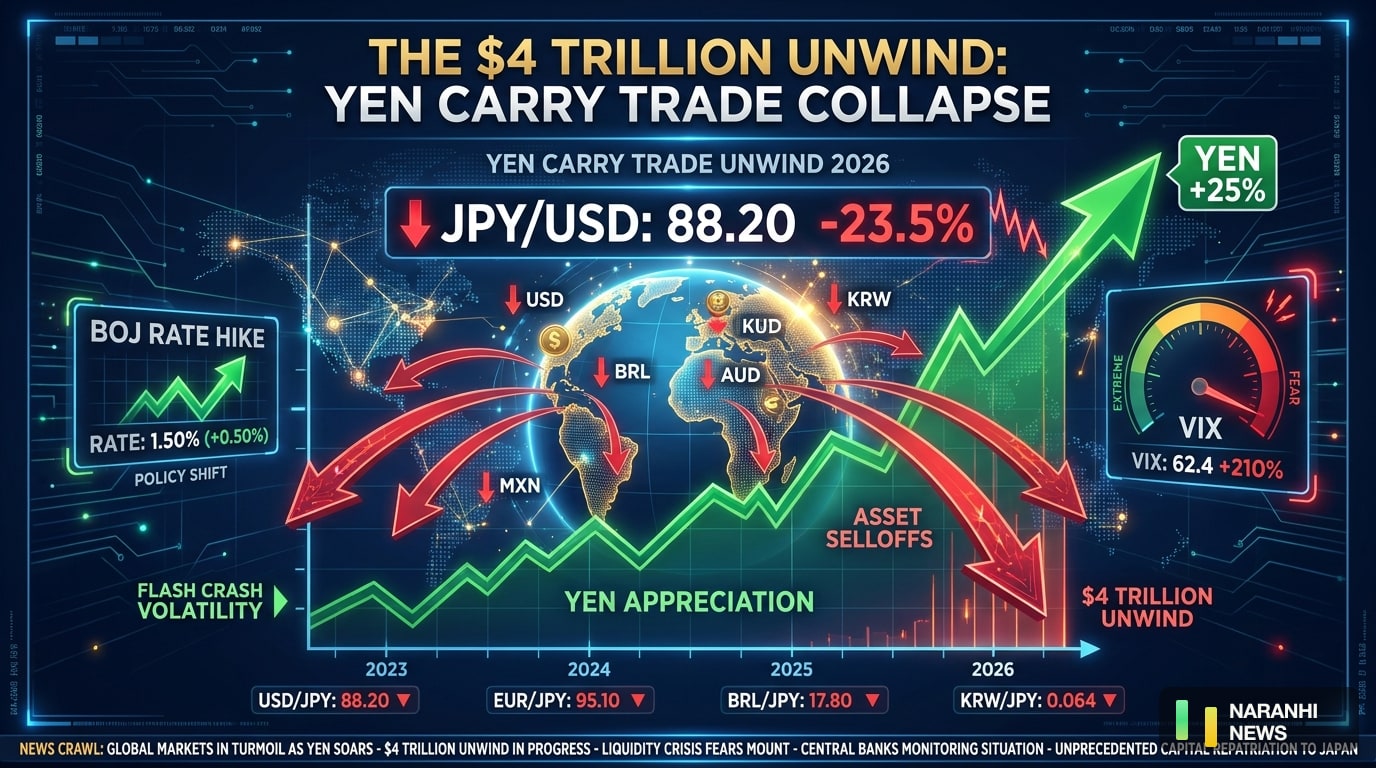
The Japanese yen has just broken past 138 per dollar — its strongest level in over a year — and in financial markets, that move is sending shockwaves far beyond Tokyo. The reason lies in a powerful but fragile trade that has quietly underpinned global markets for years: the yen carry trade. At its core, the strategy is simple — borrow money cheaply in Japan, where interest rates have been near zero for decades, then invest those borrowed funds in higher-yielding assets elsewhere in the world. The profit comes from the yield differential — the gap between Japan's near-zero borrowing costs and the higher returns available in U.S. Treasuries, Brazilian bonds, or even emerging market equities. For years, this spread made the yen carry trade one of the most popular strategies in global finance, with outstanding positions estimated at over $4 trillion.
일본 엔화가 달러당 138엔을 돌파하며 1년여 만에 최강세를 기록했습니다. 금융시장에서 이 움직임은 도쿄를 훨씬 넘어선 충격파를 보내고 있습니다. 그 원인은 수년간 글로벌 시장을 조용히 지탱해 온, 강력하지만 취약한 거래에 있습니다. 바로 엔 캐리 트레이드(yen carry trade)입니다. 전략의 핵심은 단순합니다. 수십 년간 금리가 0에 가까웠던 일본에서 저렴하게 돈을 빌려, 그 자금을 세계 다른 곳의 고수익 자산에 투자하는 것입니다. 수익은 금리 차이(yield differential)에서 나옵니다. 일본의 거의 제로에 가까운 차입 비용과 미국 국채, 브라질 채권, 또는 신흥국 주식에서 얻을 수 있는 더 높은 수익률 사이의 격차입니다. 수년간 이 스프레드는 엔 캐리 트레이드를 글로벌 금융에서 가장 인기 있는 전략 중 하나로 만들었으며, 미결 포지션은 4조 달러 이상으로 추정됩니다.
The Critical Vulnerability
But there is a critical vulnerability: the funding currency is borrowed, not owned. If the yen suddenly strengthens, the loans become more expensive to repay in the investor's home currency. A 5% yen appreciation can wipe out an entire year's worth of carry trade profits in days. That is exactly what is happening now. The Bank of Japan (BOJ), after decades of ultra-loose monetary policy, has been gradually raising rates. Governor Kazuo Ueda signaled this week that a further hike is likely at the July meeting — and the yen surged on the news. The sensitivity of the carry trade to yen movements is amplified by the involved. Most professional carry traders do not put up their own capital — they borrow in yen at near-zero rates and deploy the proceeds into higher-yielding assets, meaning that a 1% move in the yen can translate into a 5 to 10% hit on the overall position depending on the ratio used.
그러나 결정적인 취약점이 있습니다. 조달 통화(funding currency)인 엔화는 소유한 것이 아니라 빌린 것입니다. 만약 엔화가 갑자기 강세를 보이면, 투자자의 자국 통화 기준으로 대출 상환 비용이 더 비싸집니다. 엔화 5% 절상만으로도 며칠 만에 1년치 캐리 트레이드 수익 전부가 사라질 수 있습니다. 지금 정확히 그 일이 벌어지고 있습니다. 일본은행(BOJ)은 수십 년간의 초완화 통화정책을 끝내고 점진적으로 금리를 인상해 왔습니다. 우에다 가즈오 총재는 이번 주 7월 회의에서 추가 인상이 유력하다고 신호를 보냈고, 그 소식에 엔화는 급등했습니다. 엔 캐리 트레이드의 엔화 움직임에 대한 민감도는 관련 레버리지에 의해 증폭돼요. 대부분의 전문 캐리 트레이더들은 자기 자본을 투입하지 않아요. 거의 제로 금리로 엔화를 빌려 수익률이 높은 자산에 투자해요. 사용된 레버리지 비율에 따라 엔화의 1% 움직임이 전체 포지션에서 5~10%의 손실로 전환될 수 있다는 뜻이에요.
Forced Selling Across All Markets
When the yen rises sharply, investors who built up yen carry positions face a painful choice: their trades — sell the high-yield assets they bought, repay the yen loans, and take the loss — or hold on and risk even larger losses if the yen keeps climbing. The danger is not just for individual investors. Because carry trade positions are so enormous — $4 trillion is roughly the size of Germany's entire GDP — an accelerated can trigger cross-asset contagion: the forced selling of unrelated assets to raise cash for yen repayments. This explains why a BOJ rate can simultaneously crash U.S. tech stocks, Brazilian real, and South Korean won. What makes the current particularly treacherous is the concentration of carry positions in similar assets. Because many institutional carry traders use the same playbooks — borrowing cheap yen and buying US tech stocks, high-yield bonds, or emerging market currencies — when forced selling begins, multiple traders hit the same exit simultaneously, accelerating price moves far beyond what fundamentals alone would justify.
엔화가 급등하면, 레버리지 엔 캐리 포지션을 쌓아온 투자자들은 고통스러운 선택에 직면합니다. 거래를 청산(unwind)하거나 — 매입한 고수익 자산을 팔고, 엔화 대출을 갚고, 손실을 감수하거나 — 아니면 엔화가 계속 상승할 경우 더 큰 손실을 감수하고 버티는 것입니다. 위험은 개인 투자자만의 문제가 아닙니다. 캐리 트레이드 포지션이 워낙 방대하기 때문에 — 4조 달러는 독일 GDP 전체와 맞먹는 규모입니다 — 가속화된 청산은 교차 자산 전염(cross-asset contagion)을 촉발할 수 있습니다. 엔화 상환 자금을 마련하기 위해 무관한 자산을 강제 매도하는 것입니다. 이것이 BOJ 금리 신호 하나가 미국 기술주, 브라질 헤알, 한국 원화를 동시에 폭락시킬 수 있는 이유입니다. 현재의 청산을 특히 위험하게 만드는 것은 유사한 자산에서 캐리 포지션이 집중되어 있다는 점이에요. 많은 기관 캐리 트레이더들이 같은 플레이북을 사용하기 때문이에요. 저렴한 엔화를 빌려 미국 기술주, 고수익 채권, 또는 신흥 시장 통화를 매수해요. 강제 매도가 시작되면 여러 트레이더들이 동시에 같은 출구를 향해 달려가요. 이는 펀더멘털만으로는 정당화될 수 없는 수준으로 가격 움직임을 가속화해요.
This Has Happened Before
This is not a hypothetical scenario. In August 2024, a surprise BOJ rate hike triggered a global selloff — the term markets use when investors flee risky assets for safe havens like government bonds and gold. Japan's Nikkei fell 12% in a day. The S&P 500 dropped 3%. Korean equities saw the largest single-day foreign outflow in three years. Now, with the BOJ signaling another hike and the yen already breaking key levels, volatility spillover — the phenomenon where turbulence in one market rapidly infects others — is rising again. The VIX, Wall Street's "fear gauge" measuring implied volatility in the S&P 500 options market, has climbed to 22.3, its highest level since January. The 2024 episode provided a remarkably clean case study in how fast contagion spreads. When BOJ surprised markets with a rate hike on August 1, 2024, the Nikkei fell 12.4% in a trading session — the worst single-day drop in over three decades — while the VIX spiked from 16 to over 65 within 72 hours, reflecting panic that stretched well beyond any fundamental change in the underlying companies. The recovery from the August 2024 episode was rapid — markets stabilized within two weeks as BOJ signaled caution — but the speed of the selloff revealed something important: the carry trade can happen faster than any central bank can respond. By the time policymakers communicate a response, the most positions have already been liquidated, often at prices that reset entire market segments.
이것은 가상의 시나리오가 아닙니다. 2024년 8월, 예상치 못한 BOJ 금리 인상이 글로벌 위험 회피(risk-off) 매도세를 촉발했습니다. 투자자들이 국채와 금 같은 안전 자산으로 도피하는 현상을 시장에서 이렇게 부릅니다. 일본 닛케이 지수는 단 하루에 12% 폭락했습니다. S&P 500은 3% 하락했습니다. 한국 주식시장에서는 3년 만에 가장 큰 단일 거래일 외국인 순매도가 나타났습니다. 이제 BOJ가 또 다른 인상을 예고하고 엔화가 이미 핵심 수준을 돌파한 상황에서, 변동성 전이(volatility spillover) — 한 시장의 혼란이 다른 시장으로 빠르게 전염되는 현상 — 가 다시 높아지고 있습니다. S&P 500 옵션 시장의 내재 변동성을 측정하는 월가의 '공포 지수' VIX는 1월 이후 최고치인 22.3까지 올랐습니다. 2024년 에피소드는 전염이 얼마나 빠르게 퍼지는지에 대한 놀랍도록 깔끔한 사례 연구를 제공했어요. BOJ가 2024년 8월 1일 금리 인상으로 시장을 놀라게 했을 때, 니케이는 단일 거래 세션에서 12.4% 하락했어요. 30년 이상 만에 최악의 단일 일 하락이었어요. 동시에 VIX는 72시간 내에 16에서 65 이상으로 급등했어요. 기초 기업들의 펀더멘털 변화를 훨씬 넘어서는 패닉을 반영했어요. 2024년 8월 에피소드에서 회복은 빨랐어요. BOJ가 신중함을 신호하면서 시장은 2주 내에 안정됐어요. 하지만 매도세의 속도는 중요한 것을 드러냈어요. 캐리 트레이드 청산은 어떤 중앙은행도 대응할 수 있는 것보다 빠르게 일어날 수 있어요. 정책 입안자들이 대응을 전달할 때쯤이면 가장 레버리지된 포지션은 이미 청산되어 있어요. 종종 전체 시장 세그먼트를 재설정하는 가격으로요.
What to watch
The structural lesson is this: in a deeply interconnected financial system, the unwinding of a major carry trade is never just about one currency pair. It is a stress test for global liquidity — revealing which markets are the most , which investors are the most exposed, and which asset prices were artificially inflated by cheap borrowed money. Watch for movements in the yen, the VIX, and cross-border capital flows over the coming weeks — together, these three signals will tell you how much more of the estimated $4 trillion carry trade is still unwinding, and where the next shockwave in global markets is most likely to hit.
구조적 교훈은 이것입니다. 깊이 상호 연결된 금융 시스템에서, 대규모 캐리 트레이드의 청산(unwinding)은 결코 하나의 통화 쌍 문제로 끝나지 않습니다. 그것은 글로벌 유동성에 대한 스트레스 테스트입니다. 어떤 시장이 가장 레버리지(leverage)가 높은지, 어떤 투자자가 가장 많이 노출되어 있는지, 그리고 어떤 자산 가격이 싼 차입금에 의해 인위적으로 부풀려져 있었는지를 드러냅니다. 엔화, VIX, 국경 간 자본 흐름, 이 세 가지를 앞으로 몇 주간 주시해보세요. 이 신호들이 합쳐지면, 4조 달러로 추정되는 캐리 트레이드 중 얼마나 더 청산이 진행되는지, 그리고 여러분이 보는 글로벌 시장에서 다음 충격파가 어디에 가장 강하게 닿을지 읽어낼 수 있어요.
Recall
다시 읽기 전에, 떠올려 보세요
한국어 문장을 보고 빈칸에 들어갈 영어 표현을 써 보세요. 다시 읽는 것보다 기억에서 꺼내 볼 때 더 오래 남아요.
이 칼럼이 마음에 드셨나요?
새 칼럼이 발행되면 영문 + 한글 본문을 통째로 메일로 보내드려요. 매일 아침, 광고 없이.
언제든 한 번에 해지할 수 있어요.