Workplace
Your Office Apps Are Designed to Distract You — Here Is How Companies Are Fighting Back
직장 앱이 당신의 집중력을 빼앗도록 설계됐습니다 — 기업들의 반격
읽기 도움말단어 수준자주 쓰는 3,000 단어가 본문의 90%예요. 그 밖의 단어는 100단어에 10개꼴이에요.
- 1K74%
- 2K12%
- 3K3%
- 5K6%
- 5K+5%
5,000 단어 밖 shrunk · accidental · metrics · overhead · glance · quartile · collaborative · uninterrupted
Intro
Think about the last time you worked for a full hour without checking a notification, replying to a message, or switching between apps. If you are struggling to remember, you are not alone — researchers at the University of California, Irvine found that the average deep work session among knowledge workers has from 11 minutes in 2020 to just 3.2 minutes today.
마지막으로 알림을 확인하거나 메시지에 답장하거나 앱을 전환하지 않고 한 시간을 온전히 일했던 게 언제였는지 떠올려보세요. 기억이 잘 안 나도 혼자가 아니에요 — UC 어바인 연구팀은 지식 근로자들의 평균 딥워크 지속 시간이 2020년 11분에서 지금은 단 3.2분으로 줄었다는 것을 발견했어요.
The problem
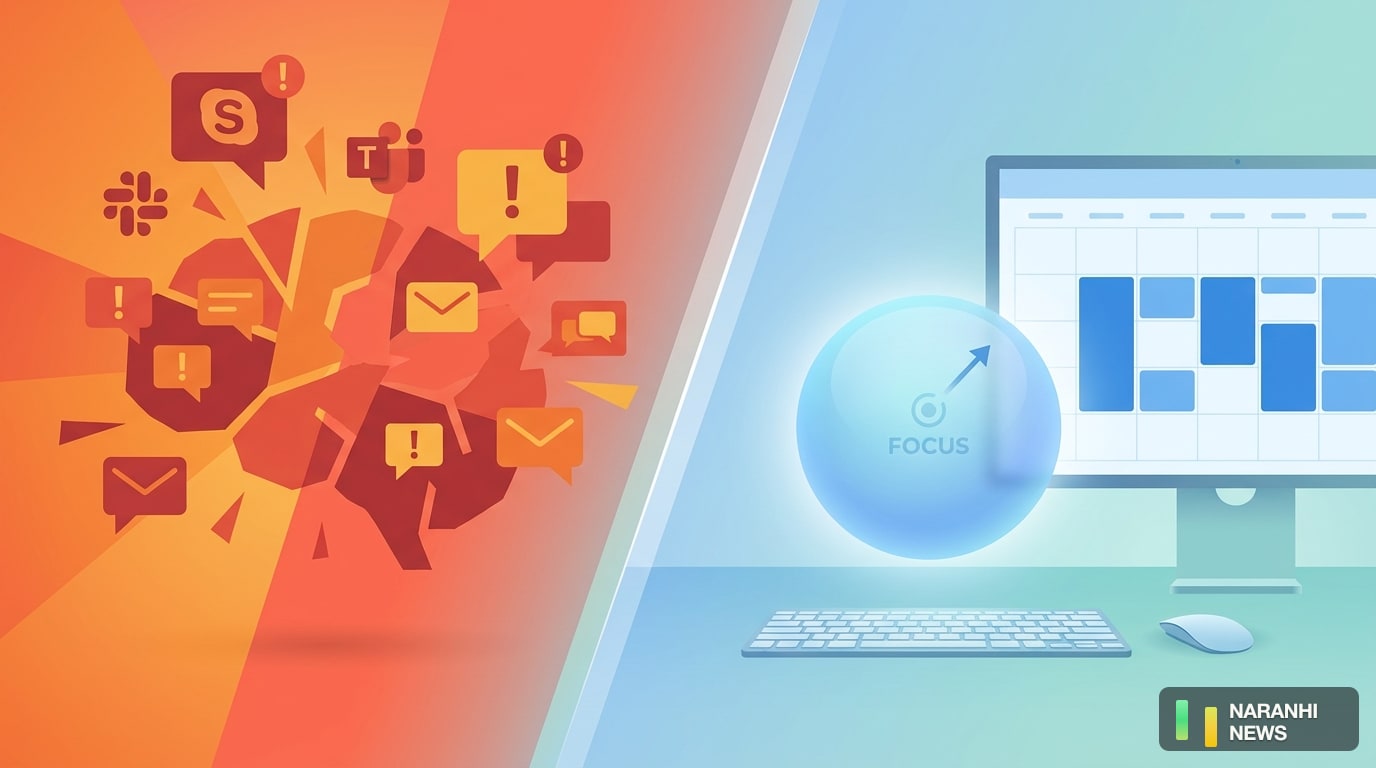
Slack, Microsoft Teams, and a growing number of project management apps have borrowed design techniques from social media — red notification dots, activity streaks, and live feeds that show who is online and what they are doing. These features are not accidental — they are designed to keep you checking, responding, and staying active on the platform, which is great for engagement metrics but terrible for cognitive overhead. Every time you at a notification — even if you decide not to respond — your brain burns focus energy that takes up to 23 minutes to fully recover, according to the same UC Irvine study.
슬랙, 마이크로소프트 팀즈, 그리고 점점 늘어나는 프로젝트 관리 앱들이 소셜미디어의 설계 기법을 그대로 가져왔어요 — 빨간 알림 점, 활동 스트릭, 누가 온라인인지 보여주는 실시간 피드까지요. 이 기능들은 우연이 아니에요 — 당신이 계속 확인하고 반응하고 활성 상태를 유지하게 만들도록 설계된 거예요. 플랫폼 참여 지표엔 좋지만 인지 부담엔 최악이에요. 알림을 힐끗 확인할 때마다 — 답하지 않기로 해도 — 뇌는 집중력 에너지를 소모하고, 완전히 회복하는 데 최대 23분이 걸린다고 같은 UC 어바인 연구는 밝혔어요.
The data
Microsoft's WorkLab analyzed productivity data across thousands of employees and found a clear pattern: the top of performers by output have 40 percent fewer meetings than the average worker. The finding does not mean high performers are less collaborative — it means they protect blocks of uninterrupted time as a competitive advantage, treating attention economy pressures as something to design around, not to.
마이크로소프트 WorkLab이 수천 명의 직원 생산성 데이터를 분석한 결과 명확한 패턴이 나타났어요: 성과 상위 25%는 평균 직원보다 회의가 40% 적었어요. 이것이 고성과자들이 덜 협업한다는 의미는 아니에요 — 방해받지 않는 시간 블록을 경쟁 우위로 보호한다는 거예요. 그들은 주의 경제의 압박을 항복할 것이 아니라 설계로 극복할 문제로 봐요.
Solutions
Shopify introduced "No Meeting Wednesday" in 2023 and has since expanded it to full "No Meeting Weeks," reporting gains in developer output and employee satisfaction scores. Basecamp, the project management company, built its entire work culture around asynchronous communication — employees are not expected to respond to messages immediately, and real-time meetings are treated as the exception rather than the rule. Researchers call this approach "deep work architecture" — designing the structure of the workday to protect focused attention rather than letting tool notifications dictate how time is spent.
쇼피파이는 2023년 '회의 없는 수요일'을 도입했고, 이후 '회의 없는 주'로 확대하면서 개발자 성과와 직원 만족도에서 측정 가능한 향상을 보고했어요. 프로젝트 관리 기업 베이스캠프는 회사 전체 업무 문화를 비동기 소통 위에 만들었어요 — 직원들은 즉시 메시지에 답할 것을 기대받지 않고, 실시간 회의는 규칙이 아닌 예외로 다뤄져요. 연구자들은 이런 접근을 '딥워크 아키텍처'라고 불러요 — 툴 알림이 시간 사용 방식을 결정하게 두는 대신, 집중적인 주의력을 보호하도록 업무일의 구조를 설계하는 거예요.
Korea context
Korean knowledge workers are among the most likely in the world to use multiple communication platforms — KakaoWork, Slack, and Microsoft Teams often run side by side, tripling the notification pressure compared to single-platform environments. The University of California Irvine study also found that the type of interruption matters: digital interruptions — notifications, messages, quick email checks — cause longer recovery times than equivalent face-to-face interruptions, because the digital variety triggers a compulsion to respond that the social norms around in-person conversation do not. Korean companies that have piloted structured deep work programs — including mobile gaming firms like Krafton and fintech companies like Kakao Pay — report that the most effective intervention is not eliminating meetings but sequencing them: clustering unavoidable meetings into defined windows leaves the remaining time genuinely free rather than fragmented.
한국의 지식 근로자들은 카카오워크, 슬랙, 마이크로소프트 팀즈를 동시에 사용할 가능성이 전 세계에서 가장 높은 편이에요 — 단일 플랫폼 환경에 비해 알림 압박이 세 배로 늘어나죠. UC 어바인 연구는 또한 방해의 유형이 중요하다는 것을 발견했어요. 디지털 방해 — 알림, 메시지, 빠른 이메일 확인 — 는 동등한 대면 방해보다 더 긴 집중력 회복 시간을 유발해요. 디지털 방해는 대면 대화의 사회적 규범이 하지 않는 방식으로 응답 충동을 촉발하기 때문이에요. 크래프톤과 같은 모바일 게임 회사와 카카오페이 같은 핀테크 기업을 포함해 구조화된 심층 작업 프로그램을 시험한 한국 기업들은 가장 효과적인 단일 개입이 회의 제거가 아니라 회의 순서화라고 보고해요. 불가피한 회의를 정해진 시간대에 모아두면 나머지 시간이 파편화되지 않고 진정으로 자유로워져요.
Quick fix
First, try notification batching: instead of responding to messages as they arrive, set two or three fixed windows per day — say, 10 a.m., 1 p.m., and 4 p.m. — to check and reply to everything at once. Your calendar is the architecture of your attention — block one 90-minute 'focus time' slot this week as non-negotiably as a meeting with your CEO, and if that block survives, add a second one next week, because protected deep work time compounds.
첫 번째, 알림 일괄 처리를 시도해보세요: 메시지가 오는 대로 답하는 대신, 하루에 두세 번 고정된 시간(예: 오전 10시, 오후 1시, 4시)을 정해 한꺼번에 확인하고 답장하는 거예요. 여러분의 캘린더는 주의력의 아키텍처예요. 이번 주 대표이사와의 미팅만큼 확고하게 90분짜리 '집중 시간' 블록을 하나 잡아보세요. 그 블록이 살아남으면 다음 주에 하나 더 추가하세요. 보호된 심층 작업 시간은 시간이 지날수록 복리로 쌓여요.
Recall
다시 읽기 전에, 떠올려 보세요
한국어 문장을 보고 빈칸에 들어갈 영어 표현을 써 보세요. 다시 읽는 것보다 기억에서 꺼내 볼 때 더 오래 남아요.
이 칼럼이 마음에 드셨나요?
새 칼럼이 발행되면 영문 + 한글 본문을 통째로 메일로 보내드려요. 매일 아침, 광고 없이.
언제든 한 번에 해지할 수 있어요.